🎤 The Defense
Yeah, you are nearly there. You handed in the thesis and you are only missing the defense. But what are the actual rules and format? Here is a short overview:
The defense is a 1 hour examination of your project where you supervisor, co-supervisors if any, and a censor will be present. You are free to invite friends and family to the defense. The format is usually like this:
The censor & and defense date
Finding a censor is not your responsibility, it is your supervisors job. The censor is a external examiner (non-DTU person) that hopefully has some experience in the field of your project.
The date of your defence date should take place no more than 2 weeks (10 working days) after you hand in your thesis. That said, it is not uncommon that a censor is not available and the defense is postponed a bit. You can make requests for the date, but in the end you need to be available for the date censor and your supervisor has time for. That said, if you have specific dates in mind talk with your supervisor early on.
-
20-25 min presentation of your project. You simply create a power-point or similar and present what you have done throughout the project. Some advice to follow
Slides
-
You should more or less follow the structure of the thesis, but I would recommend that you focus more on the parts of the project that is truly your work. By this I mean that you should not spend too much time on the motivation and background but instead of your results and discussion.
-
If you have a product to show, like a demo of some software you have written, this should be included in the presentation.
-
Never have more slides than minutes you have. 1 minute per slides is a good rule of thumb, that balance not having slides that are way to complex and slides you just click through.
-
The slides are there to support your presentation, not be the presentation. Therefore, make sure you are not just reading the slides. Instead, add notes to the slides that you can use to remember what to say.
-
-
20-25 min of questions from censor and supervisor. Do not think of this part of the defense as a test. It is more like a discussion where you either get questions to elaborate on your work or you get questions that are meant to challenge your work. This is very much a discussion instead of you just answering questions.
-
10 min of grading. You (together with friends and family) will be asked to leave the room and you need to take all your belongings with you. Supervisor and censor then discuss what grade you should get based on an overall assessment of the report, the presentation and the questions (see Evaluation below). In practice, the report is where most of your work is documented, so it naturally carries a lot of weight, while the presentation and questions give you the chance to show your understanding and can make the difference if you are on the edge between two grades.
-
You get pulled in (without friends and family) and you are told the grade. You will most likely be given some feedback for you to understand why you got the grade you got.
⚖️ Evaluation
The grade is an overall assessment of the thesis project. This means that the report, the presentation and the questions & answers session are evaluated together and not graded separately. What we measure is how well you fulfil the learning objectives for your thesis, both:
-
The general (meta) learning objectives that are the same for all theses, e.g. that you can delimit a complex open issue, apply elements of current research, communicate your results and manage all phases of a project.
-
The programme specific learning objectives for your study line, i.e. the technical competences that a graduate from your specific study line should have.
You can find both sets of learning objectives in the Read the rules section. It is a good idea to read them again before the defense and think about how your report and presentation show that you fulfil them.
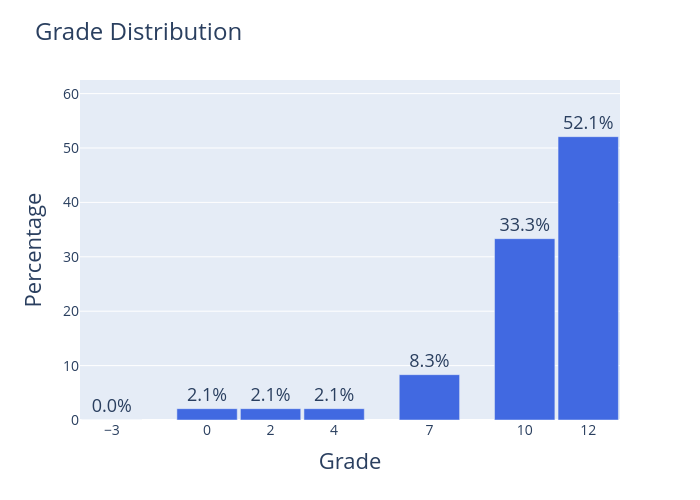
Finally, you should not be nervous. You have done the work, and you know your project better than anyone else. Just be honest and open, and you will do fine. In general, students tend to get good grades, see figure below.
That's it. You are now either a Bachelor or a Master of Science. Congratulations 🎉